Showing posts with label projects. Show all posts

Wednesday, August 19, 2009

Back to School Check List

The time has come again to begin preparing for the upcoming school year. Whether a beginner or an artist, there are a few friendly reminders that can aid each of you. Below is a check list of accessories and services that may benefit you. As always, please feel free to contact us with any questions or concerns.

Rosin
An absolute essential for every player! If the rosin has been exposed to high temperatures, touched by fingers, or is just simply broken the working components have been compromised.

A basic, yet artistic level rosin, starts around $8 for every instrument!


Strings
How long has it been since your strings have been changed? Strings typically need changed at least 1 time per year, depending on amount of time spent playing the instrument. This is because the strings get worn and either become 'dead' or 'false', resulting in an impure tone. These prices vary depending on the instrument and type of string.

We sell at the lowest price allowed, plus, upon your purchase in store we install for FREE!


Bow Rehair
When was the last time your bow has been rehaired or inspected? Bows should be rehaired approximately once per year and also checked for camber issues. A sign of needing a rehair includes build-up by the frog or tip.

We now offer bow rehair in house!

Pegs
Are those pegs just too hard to turn or creaking with every turn? We've got the solution (assuming everything is working correctly)! Stop in and we'll see if this is the quick 15 minute solution for your instrument.

This service is FREE!

As always, feel free to contact us with any questions or concerns.

Sincerely,
The Staff at A. Cavallo Violins

8705 Shamrock Rd.
Omaha, NE 68114

1.877.838.6222
402.827.9270

acvsales@gmail.com
www.acavalloviolins.com

Tuesday, August 11, 2009

Sizing Stringed Instruments

Here is a tip just in time for gearing up for the school season. Sizing a stringed instrument is a question which you will find multiple answers for. There is no absolute standard in approaching sizing of a violin, viola, or cello to a student. However, through the years, Alex has learned some general guidelines that work well.

General Guidelines for Sizing Violin & Viola Students
  • With the student standing straight with arms at side, nestle instrument into playing position on shoulder
  • Have the student reach their left arm straight out to the side, horizontal to the floor, with their palm facing up
  • The top of the scroll should meet the arm at the wrist. If the instrument is too large, it will begin to set into the palm. If the instrument is too small, it will come short of meeting the wrist.
  • The overall decision of 'pushing' a student into a larger size is typically determined by the instructor. However, a general rule is that violists can be 'pushed' more.

General Guidelines for Sizing Cello Students
  • Pull the endpin out equal-distant to the tailpiece
  • With the student sitting on the front edge of a chair and feet flat on the floor, place the cello into position
  • The curve of the scroll should sit next to the ear of the student. If the instrument is too small, the scroll will fall short of the ear. If the instrument is too large, it will rise above the student's ear.
Again, these are general guidelines that we use in shop; but there is no set standard in the business. We hope that these tips aid in the selection of a properly sized violin, viola, or cello.

-Cassandra General Manager

Tuesday, August 4, 2009

Insuring Instruments

Recently we received a very informative and well-written e-mail from Ellis Hershman our representative at Heritage Insurance Services. This is the company which provides our shop coverage, and many other shops internationally. We have copy-pasted the e-mail with Ellis' permission for your benefit. We hope that each of you find it as informational as we do.

~ Cassandra
General Manager

Use of Homeowner Policies to Insure Musical Instruments

We often get asked to explain why someone should insure their personal instruments/equipment with us, versus placing them on a schedule on a homeowner policy. Homeowner policies vary from company to company, and from policy form to policy form. Generally speaking, the most common homeowner policy is the “HO-3” policy form, which can have a special endorsement (the “HO-61” endorsement) attached to the policy at the client’s request. This endorsement covers “Scheduled Personal Property”, and is copy written by the Insurance Services Office, who then provides the insurers with the endorsement form. The most common and practical use of this endorsement is to cover valuables such as jewelry or fine arts. Even if an insurer uses their own forms and definitions for scheduled personal property, the intent shadows the HO-3 and HO-61 forms.
The basic problems with using this endorsement to insure musical instruments and equipment are as follows:

A.)
“You agree not to perform with these instruments for pay unless specifically provided for under this policy.” So reads the HO-61 endorsement. Seldom, if ever, will a homeowner carrier approve professional use of an instrument. Therefore, if you play for any remuneration at all, you have voided the terms and coverage of the policy contract.

The professional is best covered under a Heritage Musical Instrument Policy, as it is designed to cover those who earn money from the playing of their instruments.

B.) The value of the property (instruments/equipment) insured is not agreed upon, but will be ascertained ay the time of loss or damage. Even though an appra isal was requested at the placement of the coverage, the carrier may still deviate from that figure. The insurer may disagree with the insured as to the value and push the settlement into arbitration or litigation.

With an appraisal, Heritage policies provide agreed value coverage, which guarantees the amount the insured will be paid for the loss.

C.) There is nothing specific with regard to devaluation caused by breakage in the homeowner form. Claims representatives may agree or disagree on this point. Policies are quiet on this issue.

Heritage policies specifically include devaluation.

D.) Agents and employees of homeowner insurance companies generally have a very limited knowledge of musical instruments; that is, their value, devaluation, repair costs, etc. This type of knowledge can be of immense help win solving coverage and claims problems quickly.

Heritage Insurance Services maintains communication with literally hundreds of resource people in the various music trades, and uses a professional consultant to coordinate claims and valuations.

E.) Many homeowner carriers will not accept high valued musical instruments on their policies. Some companies may refuse all musical instruments and equipment.

Heritage Musical Instrument Insurance insures instruments from the low four figures to the high seven figures. Large or small values are not a problem.


F.A.Q.

If I loan or give custody of my instrument to an individual or business entity, is it covered should a loss occur?

The answer is both yes and no, depending upon some variables.

The Heritage policy designed for collectors and players will cover such entrustment on a worldwide basis, subject to the same terms and conditions that apply to the owner. So, in this case, the answer is yes.

If your policy is written by another carrier other than Heritage, you must read your policy carefully and ask the agent to define the extent of coverage. There are significant limitations placed on this exposure and it takes a trained eye to ferret them out. For instance, policies may exclude coverage while being worked upon by a repair shop, and limit the provision of coverage for mysterious disappearance or failure to return instruments. Dishonesty of entrustment can be excluded as well. So, the answer may be no, depending on your policy and the circumstances.

Beyond the issue of coverage, there is another possible consequence that should be mentioned. The word is “subrogation” and the person who takes possession of the instrument needs to understand what this means. If you relinquish custody of your instrument, you are insured and you will be paid should a loss occur, as your policy may apply to such. However, the person taking custody of the instrument is not an insured under your policy, and there is nothing to prevent your insurer from seeking restitution from that individual or entity if they discern negligence, or if they have signed a contract agreeing to be responsible for the instrument.

Someone taking custody of a non-owned instrument can avoid the subrogation process in a couple of ways:

1- If permitted by the insurer, have their name/names added to the owner’s policy for the period of the loan. (Heritage usually allows this action)

2- Add the instrument to your own policy or take out insurance on the instrument and have the owner added as a “loss payee.”

3- Have the owner waive the subrogatory interest of their carrier in writing prior to taking possession of the instrument. (Be careful; not all policies allow their policy holders to do this, so check with your agent before executing.) Heritage policies allow their insured’s to waive subrogation in writing prior to a loss occurring.

Does this really happen?

A player borrowed a bow and accidentally left it in a taxi cab and could not recover the bow. The insurer paid the loss to the owner, and turned to the player for restitution. The player wanted nothing to do with this action or responsibility, until they stepped off stage after a concert and received service of a lawsuit. The loss was substantially settled by the player without further litigation.


War Stories

This Could Happen to You!

A client with multiple homes was keeping one of his guitars at a secondary home in another part of the country from where his primary residence is located. A caretaker stopped by to routinely check on the home, and found that a water pipe leading to the hot water heater had exploded, sending gallons of water into the home. The guitar was located nearby and sustained significant water damage, having possibly been lying in water for some time before being discovered. The guitar was declared a total loss, and the client has been compensated for the full stated value of the instrument.


Heritage Insurance Newsletter, July 2009

Tuesday, July 28, 2009

Our 'Revamped' Shop

Hello all! Even with a questionable economy we have continued to burst our seams, so recently we took on a series of projects.

We began with a discussion period as to where to place and how to rearrange the shop. With a plan of action, Alex ordered 6 additional violin racks to aid in organizing and optimizing the space of our show/trial room. While waiting
for the racks to be completed, yet another organizing topic was brought to the board - the case room was, quite frankly, dis-functional and we were in need of better placement for beginner bows. Just prior to Alex's most recent road trip, the violin racks arrived and the 'revamping' began. To keep a long, agonizing, and frustrating story short it took about double the anticipated time to complete the project. With that, we would like to share photos of our most recent shop project.

We started 'smooth sailing'


We had it all laid out...


Leave it at that this was rack 5 of 6 and closing on hour 4


Finished project

Result of initial project (optimized case room)


With you, the customer, in mind we successfully completed this project to enhance your experience at the shop. Stop in and visit!

Hope to see you soon,
~ Cassandra
General Manager

Tuesday, May 26, 2009

Summer Violin Making & Restoration Workshop with Stephanie Voss


hosted by A. Cavallo Violins, LLC
July 28 - August 1, 2009

Stephanie Voss sets the highest standards for integrity in our business. From the viewpoint of restorations, she takes a conservative and careful approach to respecting old works, repairing without modifying each instrument. Her skills with set-up are exceptional and she is a caring and thorough teacher. Because of the positive response Stephanie received at our recent exhibition, we are bringing her in for a 5-day workshop for violin makers and restorers. This is open to any qualified person, but limited to 6 people total due to space.


For More Information:
Go to our website
OR
1.877.838.6222
OR
acvsales@gmail.com

Tuesday, February 10, 2009

2009 Exhibition Opening Event

The Art of Sound:
An Exhibition of Today's Master Violin and Viola Makers

OPENING EVENT:
Wine & Instrument Tasting
Saturday, March 14
7 pm
A. Cavallo Violins, LLC


Come and enjoy an evening filled with music, wine, and appetizers. William Wolcott and other artists will p
erform on instruments submitted to our exhibition. Three flights of wine will be presented throughout the evening.


Tickets: $28.00 (+ tax)
Tickets must be purchased in advance and seating is limited!


A. Cavallo Violins, LLC
8705 Shamrock Rd.
Omaha, NE 68114

Please contact us with any questions regarding our upcoming instrument exhibition.

402.827.9270
Toll-free: 877.838.6222
acvsales@gmail.com


Tuesday, June 24, 2008

Shop adventure into wholesale


Hello, I am Cassandra Johnson the new General Manager of A. Cavallo Violins, LLC. Just over one month ago I joined the team here, just as Chris ventured off to graduate school. It has been a wonderful life experiment thus far, with many things to learn and adjust to each day. Besides myself and Daniel, the summer intern joining the team, we have expanded the business from retail and online to include wholesale.

Prior to the actual instrument arrival many things were happening in the shop. Matt & Maddy vigorously re-organized the basement workshop achieving better utilization of space, labeling of parts and accessories, creative storage, tool organization, and much more. Upstairs, Daniel took on compiling a list of shops nationwide to be considered as dealers. Meanwhile, Alex and I compiled a catalog from Terms & Conditions to Inventory tables.

Within days of joining the team, boxes of violins arrived from China. We were immediately impressed with the appearance, quality, and tone of the instruments. The instruments are from a workshop that is 3 generations old, having survived time and the cultural revolution due to its locale. All wood used is from a logging operation in Tibet, owned by the same individual, and is aged and dry racked for a minimum of 10 years. Direct supervision is provided by the owner, with varnishing of the finer grade instruments completed in the United States.

Once the instruments arrived, Maddy and Matt found themselves engulfed with set-ups. Daniel, for much needed breaks from the computer, found himself in the shop polishing violins. I too, at times have found myself aiding in this step as there is simply so much to be done with a single instrument prior to sale. Maddy and Alex began discussing packing methods of fittings and instruments and arrangements were made. Time did not seem to be on our side until one Thursday evening, an hour before shop closed, Alex and I were forced into the basement for 2 hours due to severe weather which included tornadoes! During this time Alex began the inspection and completion process of the set-ups.

As time elapsed and the instrument set-ups were completed, Alex began making initial contacts with shops. This meant setting dates for the trip and making travel arrangements. It also included preparing and leaving 3 fairly new employees and an intern behind for 3 full days to manage shop!

The first trip went quite well, even though the drive was lengthened by detours due to flooding in Iowa. Now that Alex has returned we have received more violins and the entire process is beginning again... from set-ups to contacts, travel, and packing. I guess its safe to say that we have added another aspect to the everyday life of the violin shop...

Tuesday, February 19, 2008

Frog Blanks, Chinrests, Pegs: The Endless Organization of Parts

We're still recovering from unpacking all the little mini-boxes of parts from India. They're all out and accounted for but where to put them?

First up was the box full of ebony materials. The big chunk of ebony block I'm holding is used to make the frog of a double bass bow. With this much wood, you could probably divide it up and make two to four good violin bow frog blanks.

The blocks of ebony are hanging out on racks with the saddle and nuts for the various other instruments.
Our wall board of chinrests that we used to hang has now moved over to another shelf. We took some more white fold up cardboard bins and stuffed them full. The bins are now stacked upon another in one of Alex's old towering storage shelf.
As for the pegs, we had to buy some drawers for the violin and viola pegs.
Back to relabeling again.
Mad props of course to Matt Nicholson, our new official part timer, for helping us get this grunt work done. I'll have to do a profile on him for the blog.

Friday, December 7, 2007

Floor Display for the Holidays: Violin Tailpiece Ornaments, Musical Jewelry, and Plenty of Ribbons

I can't emphasize this enough in retail, especially during the holidays, but things have always got to be changing for the customers.
Granted, we don't have window shoppers that buy violins on display at the spur of the moment, but a change in their daily foot path around the plaza can get their attention.

This of course means the seasonal shifting of display stands and the layout of the shop. Laura and her mom, Nana, came to our rescue a few weeks ago to decorate the shop.

Fishing wire is always useful around the shop. Mainly for hanging violins but also for ornaments on the tree.
Laura and Nana went a bit crazy with the red ribbons as they bow tied everything in the shop.
My favorite though was the ingenious holly wreath they made from our graveyard of used chinrests, pegs.

Wednesday, December 5, 2007

Violin Website Woes

Sorry to you readers out there for not keeping up on the old blog. We've gone from three posts a week to once if we can make it due to all the business. Don't believe me? Just look at my outbox! It's overflowing with all the online customer databasing I'm having to keep up with.

Speaking of e-commerce, we've taken a massive overhaul over the old website. It's now php driven so a lot of the mechanics of the website occurs from scripts on a server. In another words, the shopping experience is now designed to be more consumer friendly and dynamically driven for searches.

Our webmaster, Nestor, has been real patient through the whole process. Alex would be constantly relaying messages during the whole developmental phase. He was also kind enough to let me in on some of the planning aspects as well. I'll have to interview about him one day in our blog. He's got an interesting background that ranges from being a talented programmer to a professional flutist.

Nestor pulls most of the strings in the website operation, but we have to do our part too. Every single item that you see on the website has to be filled out in a special form as part of the website interface. Typically each form item has the following things to fill out:

  • SKU number
  • title
  • manf.
  • description
  • short description
  • product type
  • item type
  • level (entry, intermediate,artist)
  • 1 main image path link for
  • 7 path links for images stored on the server
  • 3 options (e.g., wood: ebony, rosewood, boxwood)
  • website price
  • m.s.r.p.
  • shipping
  • oversize
  • tax (enter 0 for no tax)
  • sold out (enter 1 for out of stock items)

That's just a preview of all the details I've gone through to get this website up and running. I made the first pass by filling out the potential selling items and then Alex checked each copy. Then I'd make my second pass by uploading photos to the server for each item. Sounds easy enough, except, when one image can yield as many as four different dimensions and 7 different views. Example, a violin with its various views of its front, back, side, scroll, midsection, label, button, means each of one needs to be resized to a tiny, main, large image, and one thumbnail sized image.

(6 images x 3 sizes )+ ( 1 main image x 4 sizes)= 22 images to upload

It's also a nightmare to correctly label these image files as well. Thank goodness, Nestor found us a batch renaming software.

As of now, we've gotten most of the accessory items up. Some of the instrument images need to be updated after our upgrade in our downstairs lighting studio. All I can say is that this is an ever evolving project:)

Friday, November 23, 2007

A Brand New Website

When I first started working at A. Cavallo Violins, LLC I had some very small goals for the shop's e-commerce venture. First, startup a successful auction service with an eBay account. Second, to sell string instrument accessories through Amazon.com. And third, to revamp the old website into a clean and accessible online store. As of this week, I'm proud to say that we've reached all those goals!

Our eBay profile just about has 100 stars and we've conducted hundreds of Amazon transactions online. Now, the website is ready to go for the holidays so please check it out!

Get all your fellow musician's holiday shopping online with us but always stop by to say 'hi'.

p.s. give us some feedback on the website as it's always an evolving project.

Friday, October 12, 2007

Inventory: Bow Catalog Project

In retail, keeping track of inventory is critical. Why? (A quick business 101 digression before returning to the topic). Businesses have a love-hate relationship toward inventory. They love it when inventory sells like mad to generate cash and reap profits. They hate it when inventory sales stalls while they can't pay the bills and eat losses. Thus, the reason to keep track of what sells, what doesn't sell, and even what's missing from the original count! In other words, it's called accounting.
[As if our inventory will grow this big!]

Now, we aren't the kind of retail store that has fancy tracking systems like RFID tags or UPC bar codes. However, we do have a system that's efficient than your typical shop. All of our instruments in the shop are have a discrete "ACV" serial number inside their f-holes. All these numbers are compiled in an ever changing and expanding database as instruments come in returned, sold, or are no long with us (such as violins with a broken scroll or button).

The hardest thing to catalog in the shop has to be the bows. We've talked to other shops and they all seem to agree. Telling the difference between one bow and the next can be tough without a trained eye. Imagine the nightmare of training that new salesman to go by eye instead of a system. When I first started working at the shop, I had difficulty telling the difference between a silver and a nickel button. Can you tell the difference in the various models of frogs patterns? The convenience of a maker's stamp may help distinguish it from the others but what about the older ones with now illegible worn off stamps?

The simple solution was to use the same tagging techniques used in our ACV serial number system. However, we ran into a problem here as well. The biggest obstacle was the lack of surface area that a bow has in comparison to an instrument. The tag had to be visible to the salesman and to be of non-interference for the player's hand.

Asking around various shops, we heard of an ingenious tag solution. Apparently they drop a tiny serial number into the mortise of the frog. We thought of this option too but decided against since it's too cumbersome from a customer service standpoint. The customer would have to sit and wait as the salesman would unscrew the button, find the number in the mortise, check the database, and began his pitch.

We bounced around ideas for tags such as a thread and tag, sticker, ribbon, or a paper wrapped around the stick. Ultimately the sticker won out after a trial-and-error of wrong placements on the head, heel, thumb leather, winding, and even on the stick; all of which lead to sticky clean up situations. The next violin bow that's bought from this shop will be found on the side of the frog.

This was our grand week long project: to catalog the entire bow collection in the shop (partly the reason why the belatedness in the entries). On the old system, we were going off of Maker's Stamps, Consignment letter descriptions, and distant memories. The labelmaker churned out small strips while Lester carefully examined each bow and entered all the information into our newly created database. This one is more comprehensive than the instrument list we have. It's also very specific data fields such as maker, stamp, balance point, setting, winding, head plate, button, consignor, owner, etc...

Tuesday, September 11, 2007

Organizing Project: Hanging Cello Bags

Keeping things organized in the shop is a never ending task. I mentioned in an earlier post about our task to organize the storage bins for our new line of string instrument parts called "Alessandro Fine Fittings". It was a good excuse as well to clean the upstairs floor space, make the back office more efficient, and rearrange the traffic pattern between the workbenches.

August was the month that kept us from maintaining the place. The flurry of receiving and meeting the shipment deadlines, packing materials went astray from the designated boxes. Rental returns or traded instruments with cases and instruments were all on standby to be cleaned and restored at one bench.

Despite all this piling up of things to do, we managed to survive the back-to-school rush. The reorganization during the dead summer months payed off with a system intact. Otherwise we never would have been able to start thinking about how to organize those darn cello cases.


[cello racks, any one?]

Storing violin and viola cases isn't a big a problem. Just stack them together and stick them on the adjustable racks. The cello case though takes up more room and the majority of the ones, the soft bags, we carry have to be hung. We only have room to display the solid ones upstairs Hanging them on garment racks is the current solution for downstairs workshop that is always changing. At the same time, it's dusty so the next step in this latest organization project is to find some plastic covers. Don't even get me started on those double basses. If anyone can come up with better ideas would be great.

Related Posts:
Shaking up the Shop
Violin Fitting Organization Extravaganza

Tuesday, August 14, 2007

Tweaking the rentals

We're doing some major changes to the A. Cavallo website. The static HTML information based page will still be up and running but we are planning for a PHP data driven component as well. This means visitors can search the site for keywords and even order specific items as well. You can see some of this already on our home page with a new tab called "Rentals" is added and a brief box announcement on "Online Rentals".

Speaking of rentals, I got to help proof some of the language of the rental documents and take photos that are now on the website. We set up a couple of painter's lights in the show room gallery. Snapped some photos on a tripod, and they're online. Webmaster Nestor went back to fix up the shot with a soft lighting affect.

Sunday, August 5, 2007

Shaking up the shop

Organizing yourself in a working environment is a constant struggle in any business; in particular the physical layout of the shop. Granted, we have a great floor space, the traffic flow for doesn't lend itself well for certain areas. For example, the space between the bathroom and main computer already serves its crammed functions as a desk for reception, register, desk, and record keeping. Downstairs the two main rooms functions of storing-packing and repair-setup have disintegrated into each other. 3 weeks without Les, the arrival of the lathe, and receiving too many boxed shipments has lead to a totally disorganized basement workshop.
Organization of space is also key from a retailing perspective. It's good that we have some improvements such as instrument racks and shelves to display instruments. However, this kind of organization cannot be the only way, as things need to be flexible as time passes by. Retailers do this all the time with their seasonal sales signs that suddenly appear on the window or a new hot item on display. We try to do the same with display room layouts, as local foot traffic will glance and notice something new in the shop.

Some might feel, why bother? Just stick with a system that works. No need for this re-organization after finally settling in at home. Some shops might object to a retailer's argument for floor space change, citing all that moving for a window shopper's peek. Others may even claim their disheveled but romanticized old world shop appearance with an aging maker working in the back to be of a better selling point.

I might say to them, hey, even if those window shoppers didn't come in, it's the psychology at work here that the shop is not stuck in the past. Regular customers realize this, and even those window shoppers. Overtime, these are the people that are the first to let the locals know where to get a violin. As for the old world view of handling customers, I personally think it's rude to make them stumble through their workshop or wait on the shop's time because it was didn't keep itself organized. I also think there's a bit of a laziness and lack of ambition for making these kind of arguments :)
Having a bit of a slow week, we decided to chip away at a massive shop reorganization. I got to work on breaking down fresh boxes. Les came early in the morning to stake his new work territory to the ventilator. A craftsman's cubicle is what he's come up with, as he surrounded himself with two benches and the new lathe. Alex's bench was move behind the lathe. No easy task to move his bench, as Alex had to come in during after hours and transfer everything off to another table before he could move his.

We've also cleaned up the upstairs show room to give it a more open space. Near the window, the cases that were once on display are now on storage racks inside the studio. In it's place is display table for all of the latest bows we have stock. Moving this table has now really freed up the back room's showcase gallery. For the first time, you can take a circular path around the room to examine the instruments hanging from the wall.

Thursday, August 2, 2007

Lathe-ing away at the shop

Receiving shipments of quad violin cases, cellos, or a double bass is all cumbersome work but today we may encountered a new heavyweight contender. A semi-truck had parked next to the shop and dropped us off a wooden crate.

At first, I thought it was the arrival of Les' bow making tools that he had shipped from school. But this thing was marked fragile and Made-In-China, leaking oil from from the corners of its cover.


Lester obviously knew what it was and seemed all motivated to get cracking at the crate. With hammer in hand, he began to tear away at his special delivery package.

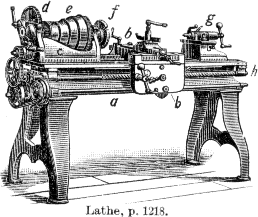
Ladies and gentlemen of the shop, please meet your new machine: the lathe!
So what exactly is a lathe? Merriam-Webster's Online Dictionary defines it for us:
Entry: 1lathe
Pronunciation: 'lA[th]
Function: noun
Etymology: probably from Middle English lath supporting stand
: a machine in which work is rotated about a horizontal axis and shaped by a fixed tool

If you've ever seen how a potter's wheel works, it has some very similar mechanical principles to it but the material is worked in a horizontal manner. The material is held in place by two horizontal axis points and spins it really fast, while a third point comes into do some precise cutting work.
I thought this was some complex cutting edge machine, but little did I realize it's been around for some time.
[Image: A lathe from 1911 showing component parts.]

The image shows its modern predecessor during the Industrial Revolution but in fact, lathes were used as far back as the Ancient world such as the Egyptians.

Enough of the history, so why the need? Mainly for Lester's repair jobs such as bushings, eyelets on the frogs, and button making. He also makes tool bits used for his bow making. Example, a prim bit he uses cuts inside the the inner mortise of the frog. However, this little tool can't be found in the store nor can they found in a craftsman tool catalog like Dicks. He had to make it by ironing and grinding it, a long and manual labor task. With the lathe, less time spent and precision tools made for better work, less work, and Les happy.

For all the necessity of Lester's work, more work was required to make this work. First, getting it transported on the dolly. A one, two, three, lift and support. Carting it inside to the edge of the stairs, a slow descent down to the shop basement. And of course, this ole' lathe needs some support, a table to be built. A shopping run out to Lowes for material and Les was hammering away.
I'll do a full blown blog about the operation of this lathe in the future for any of you tech nerds and mechanics out there. For now, we're still trying to read the instructions manual.

Thursday, July 12, 2007

Shipment of India Parts

The long awaited India parts are finally here!Due to complications such as custom inspections and floods that delayed shipping last week, a 6 week turnaround for these precious parts.It's like Christmas in July here, as we unwrap the packages and inspect each part for quality. There is a point though that when the gifts keep piling up, you simply don't know what to do with them. Our stockpile of cardboard bins for tailpiece were ready to receive them but we're still clueless on how to organize the chinrests and pegs. On top of that, we have to photograph & describe more of these new parts for Amazon under our house name "Alessandro Fine Fittings".

Tuesday, July 10, 2007

Double Bass Setups and Places to Congregate

We are back! Our boss has returned from his long needed vacation. Meanwhile we have been busily fixing and tweaking our various online sites over at MySpace, eBay, and here at Blogger. All this online social networking exciting has gotten us excited.

First off, for this posts' agenda: please check out David Heath's Double Bass Blog. For any of you bass players or makers, since there relatively few of you around, this is a much needed place for you all to congregate in cyberspace. David seems to be very active with numerous projects such as a podcast show "Contrabass Conversations" and his soon to be director position on International Society of Bassists. Some day, we'd love to have this blog as sophisticated as his but we're still a long ways from that.

Speaking of basses, when the sales rep from Texas came by with the bows, we happened to purchase a great carved bass from them to help ease their load in their already crowded van. What follows are some photos showing how this 3/4 size beast was setup.

Onto the operating table upstairs. The bass's back is protected from scratching with linen free cloth.
You can't see it in this shot, but we have a small neck rest to stabilize the instrument when the sound post is being propped up. Probing into the f-holes is the black sound post setter.

The shot of the bridge with the feet set in place seems to a simple "plop-and-drop" deal but this is actually the most difficult part. Les had to work on correctly carving out the feet of the bridge so they would match the top's surface. Small but proportionate details that can alter how the bass sounds.
This is a two man effort as the gear mechanism on bass is wound by one person and the other has to make sure the cable like strings anchored into the tailpiece and set on the right bridge notch.And there you go! Les takes it for a test drive and he's giddy as heck. It's the first time we've had a column of basses in the shop for him to try- but most importantly maintain them.


Creative Commons License
This work is licensed under a Creative Commons Attribution-Noncommercial-Share Alike 3.0 United States License.