Showing posts with label Setup. Show all posts

Tuesday, July 7, 2009

Peg Tuning Tips

Through the years, both as a violinist and teacher, one daily task seems scary for many - tuning with the pegs. I have personally never approached the task with fear, only as a challenge and necessity. One admission is that tuning with the pegs regularly presented one issue or another prior to knowledge of the following basic tips.

Peg Tuning Tips
  • If fine tuners are turned completely down or are loose, turn them to a middle range.
  • Inspect how the string is wound onto the peg. The string should be through the peg hole, then be wound evenly towards the edge of the pegbox; be sure not to cram the string against the pegbox or leave space, either of these errors will result in difficult peg tuning.
  • As turning the peg, apply inward pressure (push towards pegbox). Monitor the string, that it winds evenly towards the edge of the pegbox.
  • Turn the peg slowly, avoiding quick alterations in pitch, as this can cause a string to break.
Properly wound pegs will appear as follows.


There is no getting around tuning with the pegs, it simply takes time and patience to hone the skill. Hopefully these tips will make this daily task a bit less daunting.

-Cassandra General Manager

Tuesday, June 24, 2008

Shop adventure into wholesale


Hello, I am Cassandra Johnson the new General Manager of A. Cavallo Violins, LLC. Just over one month ago I joined the team here, just as Chris ventured off to graduate school. It has been a wonderful life experiment thus far, with many things to learn and adjust to each day. Besides myself and Daniel, the summer intern joining the team, we have expanded the business from retail and online to include wholesale.

Prior to the actual instrument arrival many things were happening in the shop. Matt & Maddy vigorously re-organized the basement workshop achieving better utilization of space, labeling of parts and accessories, creative storage, tool organization, and much more. Upstairs, Daniel took on compiling a list of shops nationwide to be considered as dealers. Meanwhile, Alex and I compiled a catalog from Terms & Conditions to Inventory tables.

Within days of joining the team, boxes of violins arrived from China. We were immediately impressed with the appearance, quality, and tone of the instruments. The instruments are from a workshop that is 3 generations old, having survived time and the cultural revolution due to its locale. All wood used is from a logging operation in Tibet, owned by the same individual, and is aged and dry racked for a minimum of 10 years. Direct supervision is provided by the owner, with varnishing of the finer grade instruments completed in the United States.

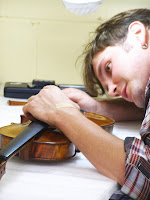
Once the instruments arrived, Maddy and Matt found themselves engulfed with set-ups. Daniel, for much needed breaks from the computer, found himself in the shop polishing violins. I too, at times have found myself aiding in this step as there is simply so much to be done with a single instrument prior to sale. Maddy and Alex began discussing packing methods of fittings and instruments and arrangements were made. Time did not seem to be on our side until one Thursday evening, an hour before shop closed, Alex and I were forced into the basement for 2 hours due to severe weather which included tornadoes! During this time Alex began the inspection and completion process of the set-ups.
As time elapsed and the instrument set-ups were completed, Alex began making initial contacts with shops. This meant setting dates for the trip and making travel arrangements. It also included preparing and leaving 3 fairly new employees and an intern behind for 3 full days to manage shop!

The first trip went quite well, even though the drive was lengthened by detours due to flooding in Iowa. Now that Alex has returned we have received more violins and the entire process is beginning again... from set-ups to contacts, travel, and packing. I guess its safe to say that we have added another aspect to the everyday life of the violin shop...

Wednesday, February 13, 2008

It's Here...The Towering Box of 3000 String Instrument Parts from India!

[whoof...sign here please]

5 Boxes full of string instrument parts, roughly 3000 or so! Verne, the UPS guy, had to heave these boxes full of goodies off the dolly after it got stuck in the doorway. Matt, our new part timer, is going to have a crash course lesson tomorrow in identifying all these parts.

[Box Henge]

We're not about to do a shipment count after a busy day. At the end of the day, we had some fun with these monolithic boxes. With a post and lentil construction and we've got our own stone henge in the shop.

Tuesday, February 5, 2008

Fresh Hank of Horse Hair for All the Rehairs We Need

hank [hangk]:

In the textile industry, a hank refers to a unit of yarn or twine that is in a coiled form. This is often the best form for use with hand looms, compared to the cone form needed for power looms. Hanks come in a fixed length depending on the type of material, so the term hank is sometimes used as a unit of measure. For instance, a hank of linen is 270 meters, and a hank of cotton or silk is 770 meters. In beads, 1 hank = 3.333 fathoms = 6.667 yards = 20 feet = 6096mm = 609.6cm = 6.096 meters.
Wikipedia.org (hank)
Fresh out of our usual stock of hair, Lester slashes open a new "hank" of horse hair for all our bow rehairing needs. Finding good horse hair for string instrument rehairs are hard to come by.
We use Mongolian Stalien Horse hair.

The hank of hair arrived in the mail. Boxed up in a long rectangular box, the hair was tightly bound with lashings of rope and a metal clip fastened the head of the hank. I couldn't help but think of images of Cousin Itt from the Adams Family.

Les has to be real careful about handling the hair, since he doesn't want any of his oils from his fingers to spread on the hair.
Ready for rehair, hung and stored in one of Les' bags behind his bench.

Random trivia that I learned from my time working here: apparently, hair is taken from male horses instead of female horses. Why? Females tend to ruin theirs overtime whenever they go to the bathroom. I have no idea if this is true or not, but it sounds hilarious. Fact check please.

Tuesday, July 10, 2007

Double Bass Setups and Places to Congregate

We are back! Our boss has returned from his long needed vacation. Meanwhile we have been busily fixing and tweaking our various online sites over at MySpace, eBay, and here at Blogger. All this online social networking exciting has gotten us excited.

First off, for this posts' agenda: please check out David Heath's Double Bass Blog. For any of you bass players or makers, since there relatively few of you around, this is a much needed place for you all to congregate in cyberspace. David seems to be very active with numerous projects such as a podcast show "Contrabass Conversations" and his soon to be director position on International Society of Bassists. Some day, we'd love to have this blog as sophisticated as his but we're still a long ways from that.

Speaking of basses, when the sales rep from Texas came by with the bows, we happened to purchase a great carved bass from them to help ease their load in their already crowded van. What follows are some photos showing how this 3/4 size beast was setup.

Onto the operating table upstairs. The bass's back is protected from scratching with linen free cloth.
You can't see it in this shot, but we have a small neck rest to stabilize the instrument when the sound post is being propped up. Probing into the f-holes is the black sound post setter.

The shot of the bridge with the feet set in place seems to a simple "plop-and-drop" deal but this is actually the most difficult part. Les had to work on correctly carving out the feet of the bridge so they would match the top's surface. Small but proportionate details that can alter how the bass sounds.
This is a two man effort as the gear mechanism on bass is wound by one person and the other has to make sure the cable like strings anchored into the tailpiece and set on the right bridge notch.And there you go! Les takes it for a test drive and he's giddy as heck. It's the first time we've had a column of basses in the shop for him to try- but most importantly maintain them.

Friday, June 29, 2007

eBay Cello prep

If you haven't noticed, we do a lot of things besides the old retail activities that take place in the brick and mortar world. With Amazon.com & eBay, we've been able to go regional and national! Of course, this inevitably means more work on our part to consign and sell in a proper manner.

Take for example eBay. We just started last August with a few instruments thrown up there for practice and experimentation. eBay is referred to as the "Wild West" around the shop because of its quirks of penny bids, buy-now's, trick photography, incomprehensible descriptions, etc. Well, all of that isn't meant to be negative, since there are plenty of sharks, speculators, or amateur collectors that are out there for a bargain.

So, as trained pros at a violin shop what can we do to help buyers from being so wary? Well, for one, we're up front and honest about the condition of the instrument. This of course means taking photos of any damages or repair work, citing correct measurements, and even encouraging bidders to ask us questions. Second, we take a lot of time in preparing each auction item. We do any repairs setups that we're willing to risk, polish it up, photo-shoot, and deliver with insured packing.

Today, we're prepping another item up for bid. A hand carved German cello that's been consigned to us for auction online. The top has taken a beating with some significant cracks near the sound post and bass bar. The consignor says, "Sell it as is," but at the bare minimum we have to glue up some open seams and polish away its grime.

I'll have to show you another series on the glue process for closing seams but here is the cello with its clamps

The polish you're seeing being used is a water based. Something to keep in mind for all you string players out there, stick to this type since others can strip the varnish. Although it is a liquid, it contains tiny granules that smooth the surface when rubbed. It's the same idea used in polishing a camera lens. More careful polishing steps to be discussed in the future posts.

Next, the cello is sent to our mini lighting studio for a photo shoot. It's another make shift project worth blogging about. Here's the cello with lights, camera, and action.

And finally, thanks to software such as eBay's TurboLister, it enables us to crank out templates of listing descriptions that can be tweaked and modified. Will show you the results of the listing in the coming days.

Wednesday, June 27, 2007

Bridge Carving

In a last minute rush to the post office, we had to setup a 14" viola right away but the bridge wasn't finished. Sandpaper and knife, the kidneys and the heart of the bridge needed some smoothing out.
In other news, we've managed to label and organize all the bins for parts...well, at least of all the tailpieces we need. We still have endbuttons, chinrests, and pegs to go!


Creative Commons License
This work is licensed under a Creative Commons Attribution-Noncommercial-Share Alike 3.0 United States License.